Approach
Not the correct interpretation – but rather a possible approach.
The focus areas of VertrauensKunst are relationship, security, and expression. A conversation can complement artistic work—depending on what is helpful and viable in the moment.
It is not the point to do “right” or to explain a picture. A therapeutic process can rather offer space to recognize experiences, to structure them, and to express them, as well as to develop new perspectives.
Basic Attitude
Relationship before Method
Therapeutic methods can be helpful. They work, however, only when they are supported by relationships, security, and the individual context of a person.
That’s why I don’t start with the question, “Which technique is best here?” Instead, I start with: “What is needed to ensure contact, orientation, and a viable next step is possible?”
Occasionally the conversation takes priority. Sometimes it’s a picture, a material, or an action. Sometimes it’s important, at first, not to create anything at all.
The process may develop on its own, without being forced to do so.
Principles
What defines the therapeutic framework
Safety
Resilience, pace, and limits are considered. Stabilization can be more important than rapid change.
Options
You help decide what you want to share, try out, create, or leave open for now.
Relationship
Therapeutic work emerges through interaction. Methods support this process but do not replace it.
Meaning arises together
Images and materials are not interpreted according to a fixed system of symbols. Meaning can emerge in dialogue and from your own perception.
Artistic expression
When experience requires a different language
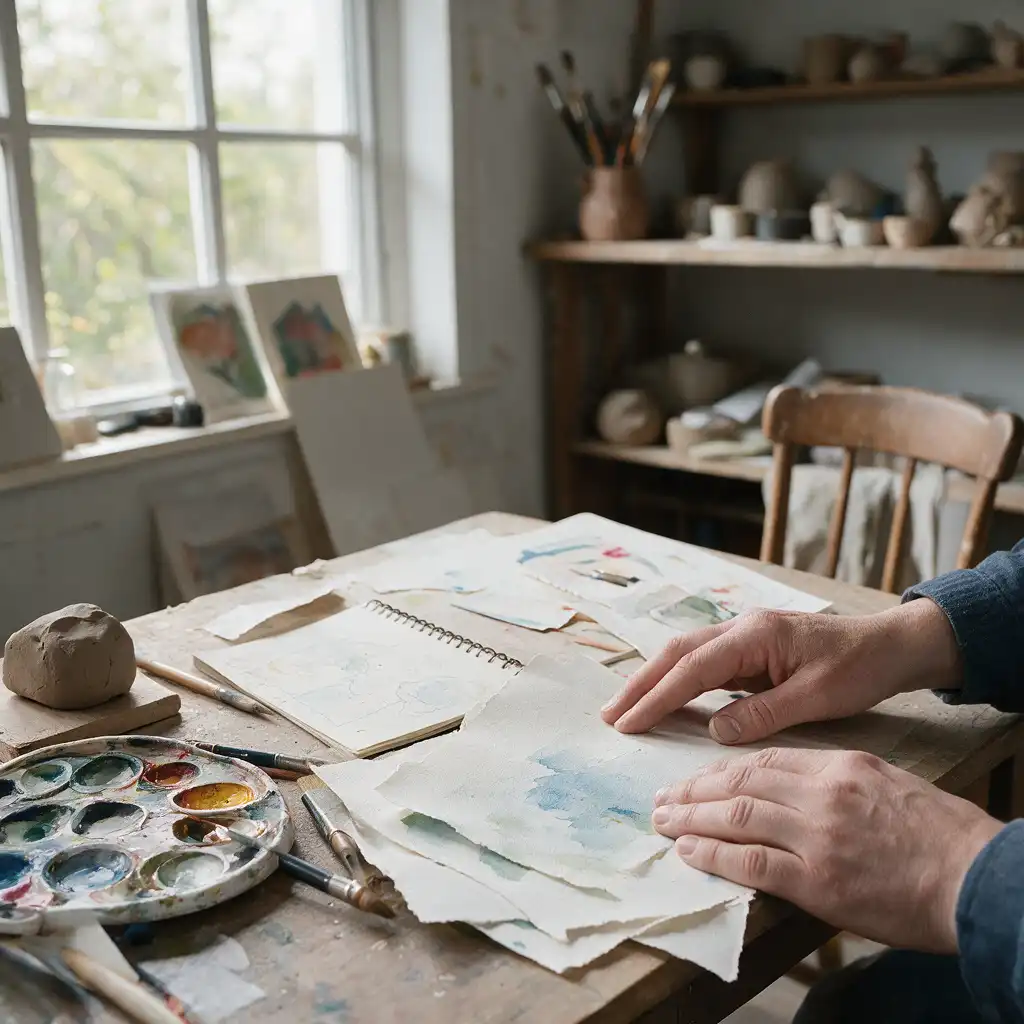
Artistic expression can provide an alternative means of communication when words are hard to come by, too overwhelming, or simply insufficient.
Color, line, form, material, and movement can help make something visible or tangible without having to explain it fully right away.
The focus is not on the result. A picture does not have to be beautiful or technically perfect.
Sometimes even just the decision to choose a material, a color, or a position in space is part of the therapeutic process.
You don’t need any prior artistic experience.
Integration
Different perspectives—a shared framework
Depending on your needs, we can combine various therapeutic approaches. We don’t apply them as a rigid program, but in a situation-specific, transparent way.
Art Therapy
Working with images, materials, color, form, and nonverbal expression.
Systemic
Exploring connections, relationships, roles, and interactions within the context of your own life.
Humanistic
Focusing on experience, relationships, self-perception, and personal meaning.
Resource-oriented
Bringing existing abilities, supportive experiences, and scope for action to light.
Narrative
Exploring one’s own stories, meanings, and self-images, and potentially retelling them.
Trauma-informed
Considering safety, stabilization, regulation, and a gradual approach to distressful experiences.
During the session
What a session might look like
No fixed sequence must be the same for every session. Nevertheless, a therapy session may include some recurring elements.
1
Arrival
What is present today? What needs attention—and what perhaps not yet?
2
Orientation
Together, we’ll figure out the focus and which approach feels right.
3
Exploration
This can happen through conversation, artistic material, or a combination of both.
4
Perception
What stood out during the process? What has changed, intensified, or calmed down?
5
Integration
We’ll see what useful insights we can take away from the session and what we can leave open for now.
Setting Boundaries
What you don’t have to expect
I do not interpret your images according to a fixed system of symbols.
You don’t have to create anything “beautiful” or “correct.”
You don’t have to describe traumatic experiences in detail until you feel sufficiently safe.
You are not obligated to work artistically if a conversation or another form of interaction is more helpful.
I don’t promise quick or guaranteed results.
Orientation Model
S.A.R.I.A. – a possible process framework
Therapeutic processes rarely follow a linear path. The S.A.R.I.A. model is therefore not intended as a rigid step-by-step model but rather as a guide to the issues and tasks that may be important in the various phases.
S · Stabilization
Safety, orientation, and regulation strengthen.
A · Approximation
Approach difficult topics carefully and in small steps.
R · Restructuration
This involves taking a fresh look at experiences, meanings, and possible courses of action.
I · Integration
Integrating new experiences into one’s self-image and daily life.
A · Adaptation
Test and refine changes in everyday life.
Get to Know Us
The approach is best experienced through interaction.
If you want to see whether this frame might be a good fit, we can start with a relaxed introductory meeting. At this point, you don’t need to decide whether you want further counseling support.