About
For me, art, relationships, and trust go hand in hand.
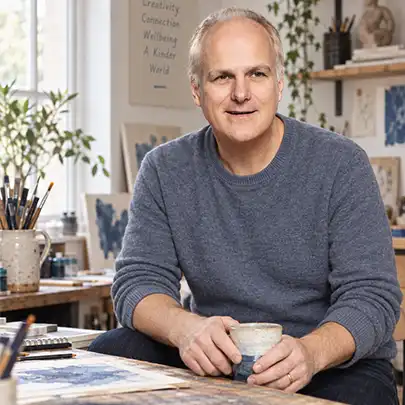
My name is Stefan Schaffeld, and I support people when words alone aren’t enough—by offering time, attention, artistic expression, and a professionally guided therapeutic setting.
It’s not about having to portray, explain, or achieve anything in particular. Rather, I’m interested in what emerges when there is enough security, connection, and space.
My Path
Between art and therapeutic work
For many years, my work has straddled the realms of artistic practice, psychosocial support, and the question of how people can express experiences that cannot easily be put into words.
Art was, for me in this context, never just a technique. It can open up its form of awareness, exploration, and relation-building.
In my therapeutic work, I combine this artistic perspective with a systemic, humanistic and trauma-sensitive approaches.
The therapeutic relationship remains the framework within which artistic and creative expression can take on meaning.
Attitude
What my work supports
01
Safety
A sustainable process requires a framework in which boundaries can be recognized and respected. This framework—or space—is based on trust and a sense of belonging.
02
Relationship
Therapeutic work does not arise from a single method alone but rather from a reliable and respectful therapeutic relationship. Likewise, this occurs through the process of shaping and ultimately also through the relationship with the created work.
03
Autonomy
You retain the ability to make decisions. I aim to open up possibilities, not to impose interpretations or solutions. You are the competent person within the therapeutic relationship.
04
Expression & Impression
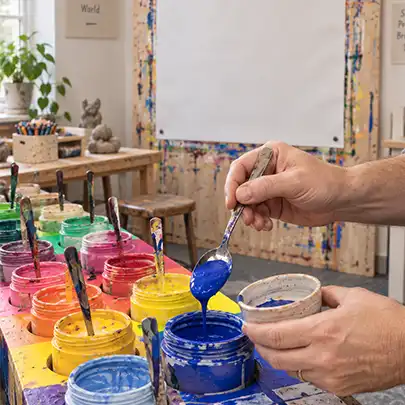
Words are important—but not always sufficient. Color, form, material, and action can open up additional avenues of expression. In this process, the created work exerts an influence through the impression it makes on you.
Approach
Not the “right” interpretation—but a possible approach
In my work, the focus is not on “analyzing” a picture or assigning it a fixed meaning.
Rather, materials, forms, movements, and images can help explore perceptual experiences, manage distance or closeness, regulate emotions, and relate experiences in a different way.
Depending on the specific needs, art therapy, systemic, resource-oriented, narrative, trauma-adaptive, or ego-states approaches can be combined.
Professional Background
Combining artistic and therapeutic perspectives
My professional training combines therapeutic, systemic, and artistic perspectives. These different approaches enable me to support people both through language and through creative and nonverbal forms of expression.
Heilpraktiker für Psychotherapie
License to practice medicine
in the field of psychotherapy
Trauma-informed Art Therapy
Training in Trauma-Adaptive Art Therapy (TAKT) /
Working with Complex Trauma-Related Disorders
and Ego States
Art Therapy
Training in Mal- und Gestaltungstherapie (Creative Arts Therapy) /
Art Therapy Practice
Systemic Work
Systemic Coach and Consultant
BA Fine Arts
University for the Creative Arts, UK
MA Intercultural Practices
University of the Arts London, UK
Attitude
What is important to me in counseling
I do not believe that people need to “function” as quickly as possible..
Change can begin quietly—with a first safe connection, a line on paper, a material in the hand, or a moment when something doesn’t yet need to be explained.
I see my role as providing a professional setting, listening attentively, opening up possibilities, and exploring with you what might be helpful.
Trust does not grow through pressure.
It can develop when there is space for a relationship.
Get to Know Us
Perhaps you’d like to start by simply checking if it fits.
During a relaxed introductory meeting, you can ask questions, get to know the framework, and get a first impression—without having already decided to seek further counseling.